
SEO: Complete Guide to Improving Your Website Visibility and Growing Your Business Online
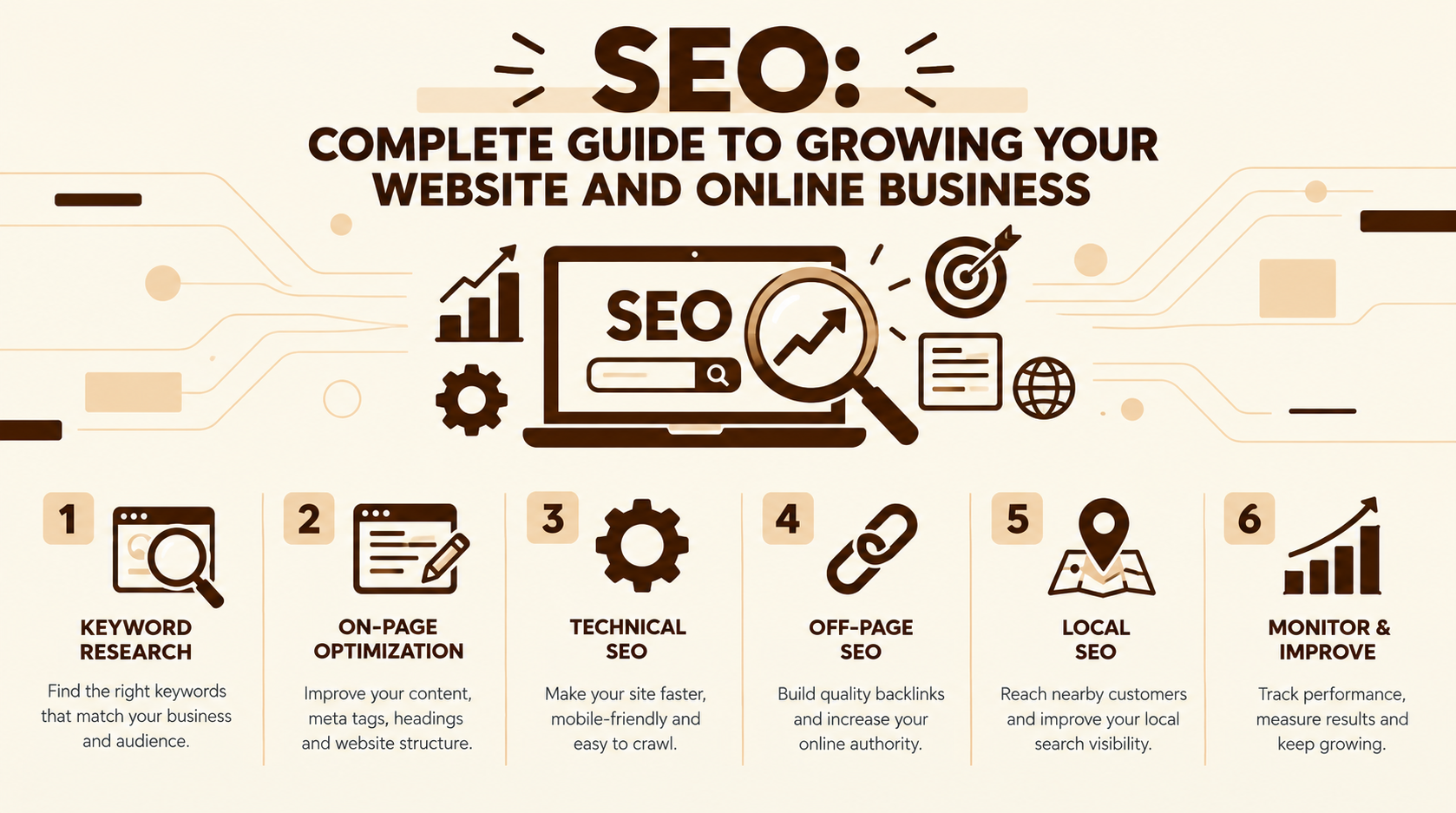
SEO: Complete Guide to Growing Your Website and Online Business
In today’s digital world, having a website is only the beginning of building an online presence. Millions of websites compete for attention every day, making it important for businesses to find effective ways to reach potential customers. SEO is one of the most valuable digital marketing strategies for improving a website’s visibility and attracting people who are actively searching for products, services, or information.
Whether you own a small business, run an online store, manage a personal brand, or work with a large company, SEO can help your website appear in relevant search results. When your website becomes easier for search engines and users to understand, you have a better opportunity to attract organic visitors.
A successful SEO strategy is not about adding keywords to a page repeatedly. It involves improving website content, technical performance, user experience, authority, and relevance. This guide explains the fundamentals of SEO, its benefits, important strategies, common mistakes, and how it can support long-term business growth.
What Is SEO?
SEO, or Search Engine Optimization, is the process of improving a website so that it can achieve better visibility in search engine results.
Search engines such as Google use complex systems to understand and rank web pages. They consider many factors when deciding which pages are most relevant to a user’s search.
A good SEO strategy focuses on helping search engines understand your website while also providing useful information to visitors.
For example, if someone searches for “best digital marketing services,” search engines try to identify pages that provide relevant, useful, trustworthy, and high-quality information.
The goal of SEO is to make your website a strong candidate for relevant searches without relying entirely on paid advertising.
Why Is SEO Important for Businesses?
The internet has changed how customers discover businesses. People often search online before purchasing a product, booking a service, visiting a store, or contacting a company.
This makes SEO an important part of a modern digital marketing strategy.
A website with strong search visibility can attract visitors without paying for every individual click. Organic traffic can continue to provide value when a website consistently publishes useful content and maintains good optimization.
Some important benefits include:
- Increased website visibility
- More organic traffic
- Better brand awareness
- Higher-quality visitors
- More potential leads
- Improved online credibility
- Long-term marketing value
Unlike some short-term marketing campaigns, it can create a foundation for sustainable online growth.
How SEO Works
Search engines generally need to discover, understand, and evaluate web pages before displaying them in search results.
When a search is performed, the search engine tries to provide results that best match the user’s intent.
Several factors can influence how a page performs.
These can include:
- Content quality
- Search relevance
- Website structure
- Page speed
- Mobile usability
- Links
- Website authority
- User experience
- Search intent
A successful strategy focuses on improving the overall quality and usefulness of a website.
Keyword Research in SEO
Keyword research is one of the basic parts of SEO.
Keywords are the words and phrases people type into search engines when looking for information, products, or services.
For example, a business providing digital marketing services might target phrases such as:
- Digital marketing services
- SEO services
- Digital marketing expert
- Social media marketing services
- Website marketing services
Keyword research helps businesses understand what their target audience is searching for.
However, choosing keywords should not be based only on search volume. Relevance and search intent are equally important.
A good SEO strategy selects keywords that are connected to the business and likely to attract the right audience.
On-Page SEO
On-page SEO focuses on elements that can be optimized directly on a website.
Important on-page elements include:
Title Tags
The title tells search engines and users what a webpage is about. A clear and relevant title can help improve the page’s visibility and encourage users to click.
Meta Description
A meta description provides a short summary of the webpage. While it is not usually a direct ranking factor, a useful description can make a search result more attractive.
Headings
Headings help organize content into clear sections. Using H1, H2, and H3 headings can make a long article easier to read.
Content
Content should answer the user’s question and provide genuine value. It should be original, clear, relevant, and easy to understand.
Internal Links
Internal links connect different pages on the same website. They help visitors discover additional content and can help search engines understand the website structure.
Strong on-page SEO creates a better experience for both search engines and users.
Technical SEO
Technical SEO focuses on the technical parts of a website that affect crawling, indexing, performance, and usability.
Important areas include:
- Website speed
- Mobile responsiveness
- Secure HTTPS connection
- XML sitemap
- Robots.txt
- Website structure
- Crawlability
- Indexing
- Broken links
- Core performance factors
A technically strong website makes it easier for search engines to access and understand its pages.
For example, if a website loads very slowly or has important pages that cannot be properly crawled, its search performance may suffer.
Local SEO for Businesses
Local SEO is particularly useful for businesses that serve customers in a specific location.
People frequently search for services using location-based terms such as:
- Restaurants near me
- Digital marketing services in Kochi
- Best salon in Malappuram
- Web designer in Thrissur
- Photographer in Calicut
Businesses can improve their local visibility by optimizing their Google Business Profile, using relevant location-based content, maintaining accurate business information, and collecting genuine customer reviews.
Local SEO helps businesses connect with customers who are searching for nearby products and services.
For small and local businesses, this can be an effective way to compete with larger companies.
Content Marketing and SEO
Content and SEO work closely together.
Search engines need content to understand what a website offers. At the same time, users need useful information to solve problems and make decisions.
A strong content strategy can include:
- Blog articles
- Guides
- FAQs
- Case studies
- Videos
- Infographics
- Social media content
- Service pages
For example, instead of creating a service page that only promotes a product, a business can also publish articles answering common customer questions.
This approach can attract people at different stages of the buying journey.
Good SEO content should focus on helping the reader first while naturally incorporating relevant search terms.
Off-Page SEO
Off-page SEO refers to activities that take place outside your website and can contribute to its authority and reputation.
One important area is link building.
When reputable websites link to your content, those links can help search engines understand that your website may be a valuable resource.
However, quality is more important than quantity.
Businesses should avoid creating large numbers of unnatural or low-quality links simply to manipulate rankings.
Other off-page activities can include:
- Digital PR
- Brand mentions
- Business listings
- Industry relationships
- Relevant partnerships
- Content promotion
A strong off-page SEO strategy focuses on building genuine authority and online credibility.
Mobile-Friendly SEO
A large percentage of internet users access websites through smartphones.
Because of this, having a mobile-friendly website is essential.
A mobile-friendly website should:
- Load quickly
- Have readable text
- Use easy navigation
- Display properly on different screen sizes
- Make buttons easy to use
- Provide a smooth browsing experience
Mobile usability is an important consideration when developing an SEO strategy.
A website may have excellent content, but if users struggle to navigate it on their phones, they may leave quickly.
SEO and User Experience
Modern SEO is closely connected with user experience.
Search engines want to provide users with helpful results. Websites that provide a poor experience may struggle to keep visitors engaged.
Good user experience includes:
- Simple navigation
- Clear information
- Fast loading pages
- Useful content
- Easy-to-read layouts
- Clear calls to action
- Mobile compatibility
The goal should not be to optimize a website only for search engines.
Instead, businesses should create websites that are useful for real people while following good search optimization practices.
Benefits of Long-Term SEO
One of the biggest advantages of SEO is its potential for long-term value.
Paid advertising can provide immediate visibility, but the traffic usually depends on an active advertising budget.
Organic search can continue bringing visitors when pages maintain strong visibility and remain useful.
Long-term SEO can help businesses:
- Build organic traffic
- Increase brand visibility
- Generate leads
- Establish authority
- Reduce dependence on paid traffic
- Reach customers with search intent
However, results do not usually happen overnight.
Search optimization requires research, implementation, monitoring, and continuous improvement.
Common SEO Mistakes to Avoid
Businesses sometimes make mistakes when trying to improve their search rankings.
Some common mistakes include:
Keyword Stuffing
Repeating a keyword excessively can make content difficult to read and may create a poor user experience.
Duplicate Content
Publishing copied or substantially duplicated content can reduce the value of a website.
Ignoring Mobile Users
A website that works poorly on smartphones can lose potential visitors.
Slow Website Speed
Slow pages can negatively affect user experience and make visitors leave.
Poor Internal Linking
Without useful internal links, visitors and search engines may have difficulty discovering important pages.
Buying Low-Quality Links
Unnatural link-building practices can create risks instead of helping a website.
Avoiding these mistakes makes an SEO strategy more sustainable and user-focused.
How to Create an Effective SEO Strategy
Creating an effective SEO plan starts with understanding your business and your customers.
A basic process can include the following steps:
Step 1: Set Clear Goals
Decide what you want to achieve.
Your goal could be more website traffic, leads, enquiries, sales, or local visibility.
Step 2: Research Your Audience
Understand what your potential customers are searching for and what information they need.
Step 3: Conduct Keyword Research
Find relevant keywords that match your products, services, and audience.
Step 4: Audit Your Website
Check technical performance, content, mobile usability, page structure, and existing search visibility.
Step 5: Improve Existing Content
Update outdated pages, improve readability, add useful information, and optimize relevant elements.
Step 6: Create New Content
Publish helpful articles and resources that answer questions related to your industry.
Step 7: Build Authority
Promote valuable content and develop genuine relationships that can lead to quality mentions and links.
Step 8: Monitor Performance
Use analytics and search performance data to understand what is working and where improvements are needed.
This structured approach makes SEO more organized and measurable.
SEO for Small Businesses
Small businesses can benefit greatly from search optimization.
A local business does not necessarily need to compete with every company on the internet. Instead, it can focus on relevant searches from its target location and audience.
For example, a small service provider can optimize its website for specific services and locations rather than targeting extremely broad keywords.
Local pages, useful blog content, customer reviews, and an optimized business profile can all contribute to better online visibility.
With consistent SEO, small businesses can gradually build authority and attract customers searching for their specific services.
Measuring SEO Performance
Measuring performance is essential because it helps businesses understand whether their efforts are producing meaningful results.
Important metrics may include:
- Organic traffic
- Keyword visibility
- Search impressions
- Search clicks
- Click-through rate
- Leads
- Conversions
- Engagement
- Local search visibility
It is important not to focus only on rankings.
A keyword ranking improvement is useful, but the ultimate goal is usually to attract relevant visitors and turn those visitors into customers.
Effective SEO therefore connects search performance with actual business objectives.
The Future of SEO
Search behaviour continues to evolve as technology changes.
Search engines are becoming better at understanding natural language, user intent, context, and content quality.
Businesses should therefore avoid relying on outdated tactics.
The future of SEO will continue to focus on:
- Helpful content
- Search intent
- User experience
- Mobile performance
- Technical quality
- Trust
- Authority
- Relevant information
Businesses that consistently provide useful experiences are better positioned to adapt as search technology develops.
Final Thoughts
SEO is more than simply adding keywords to a website. It is a complete process of improving visibility, content, technical performance, user experience, and online authority.
For businesses that want sustainable online growth, investing time in SEO can provide valuable long-term opportunities. A well-optimized website can attract people who are already searching for the products, services, or information a business provides.
The most effective approach is to start with clear goals, understand your audience, research relevant keywords, create helpful content, improve your website, and regularly monitor performance.
Whether you are a small local business, freelancer, startup, or established company, SEO can become an important part of your digital marketing strategy.
The key is consistency. Search visibility takes time to build, but with quality content, technical improvements, user-focused optimization, and continuous analysis, businesses can create a stronger online presence and attract more relevant customers.
SEO is a long-term investment in your website’s visibility, credibility, and growth.